Does a Nobel Prize Automatically Make You Correct?
My attention has been recently brought again to the book: Thinking, Fast and Slow. There is so much ‘work’ out there to comment on that it would take many lifetimes to cover it all, but this one hits me right in the gut: it’s about heuristics. This post will delve into the misconceptions in the book regarding a heuristic and heuristics in general with respect to mind, thought and, most importantly, knowledge and its representation.
Of course there are many insightful aspects to the book and I hope this post induces people to buy and read the book! It is definitely worth that effort! There is much truth in the book and useful considerations regarding the psychology of thought (at least for me).
There is a universal constant in our universe that I call the ‘Near and Far Contraposition’. This constant is responsible for the effect we experience when we look at things close up verses far away. It ‘makes it’s appearance’ when we say things like; “He can’t see the forest for the trees.” I will describe this constant more below as time permits me to do so.
His System 1 (Intuition) is, in reality, taking relational bearing on entities involving deeper scope (among other factors) than in his System 2.
Whereas his System 2 is taking that relational bearing with entities involving more shallow scope (among other factors) to entities than in his System 1.
His systems will be shown to be completely unnecessary. There are ‘systems’ within consciousness, but they are not where Daniel says they are.
I’m amazed that someone of his depth is unable (or unwilling) to recognize this!
Your thoughts are welcome too. We all are impacted by this artificial environment created for us that causes stress and economy in our lives. It is possible to an extent to ‘divorce’ ourselves from these frenetic states, but when our customers do not ‘cooperate’ (due to different priorities, perspectives and needs) with our efforts, then it does present challenges for us.
Knowledge Representation – Self and Other
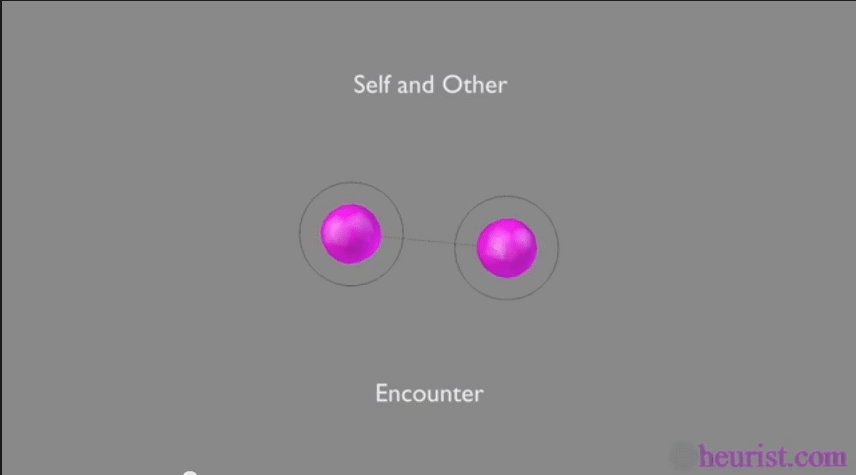
Knowledge Representation of Self and Other
This knowledge representation, which I made for a presentation in Nürnberg on April 29th, 2013, depicts a partial resonance domain with respect to sentient relation and orientation. The representation is not designed to be comprehensive in any respect, rather it is intended to help those who are not accustomed to viewing knowledge in this way.
It shows how, to quote Carl Sagan: “One voice in the Cosmic fugue.” can be represented more generally. There are certainly other possibilities with respect to relation and orientation between self and other.
You may need to stop this video occasionally as some of the transitions occur very quickly.I’ve indicated what is happening in the representation to aid in the interpretation of what is being shown.
I would appreciate any feedback you may want to give. I’d be pleased to answer any questions that may arise.
Thank you for watching!
UPDATE:
A question has come in from an anonymous source asking for clarification on the use of “Resonance Domain”.
A resonance domain is comprised of resonance fields. When one or more fields are being examined, the group is called a domain.
For further clarity I’d like to add that we are looking at two separate fields (sentient beings) in terms of the relation they participate in and the orientation they share with each other.
Fields are always composed of other sub-fields and contain even partial fields from other sources!
UPDATE: “Why do you use the word ‘sentient’ in your description?”
There are basically three types of entities in our universe:
1) Having some measure of interiority (concept of self).
2) Artifacts
3) Heaps
‘Self and other’ can come in any number of combinations:
The knowledge representation above requires that at least two of the participants are of type 1 (sentience) for this knowledge representation to hold.
Examples:
Type 1) human and type 1) dog will work.
Type 1) human and type 2) book will not work.
Type 1) human and type 3) rock will not work.
This way of looking at our Kosmos (multiverse) is called Mathesis Universalis.
For those interested in more on the subject, go to http://mathesis-universalis.com.
[PS: There are also the conditions that both participants are conscious of each other and that their shared consciousness is such that differences in semantics between them are ‘reconcilable’ (coherence). (for the scientists/mathematicians among us!)] 😉
 Heurist.me (Carey G. Butler)