Good News! It’s Not Just Particles! It’s Properties and Patterns of Particles! – Max Tegmark
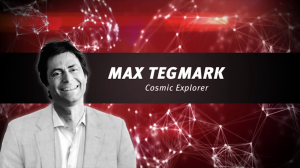 “Consciousness is a mathematical pattern.”
Is it possible to explain the phenomenon of purpose away with another phenomenon of emergence?
I wonder how he defines purpose itself?
Isn’t consciousness more than our senses?
Why are we only looking at states of matter and leave out stages, lines, levels, types,…?
Who is doing the “feeling” he’s describing?
Who gives the particles their work to do?
How are the particles different between dead and living beings?
So we are to replace our questions with a certainty of the phenomenon of consciousness and then explain that in terms of an interpretation of same?
I’m not a religious person, but the video is starting to sound like I should be one!
Is this what we get when a physicist tries to do philosophy? Oh my!
Knowledge Is What Awareness Does – Knowledge Representation as a Means to Define Meaning Precisely
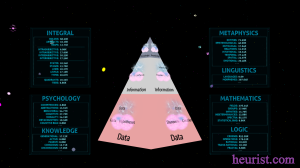
Knowledge Representation as a Means to Define Knowledge Precisely
Video is finally here!
Self-referential Paradoxum In Knowledge Representation

What do these two pictures share in common?
They represent structure and dynamics (continuity, connectedness, and boundary [of which topology is only ONE example!]) distributed over multiple and partial dimension. That’s why they interest me and are of use. I use them to represent knowledge, because they are found in our knowledge!
They always have a concealed twist (internal dynamics). You need to leave our 3D rational domain to capture their meaning though. I’ve studied these shapes for a long time now and use them in my work. Break the figures or logic apart and notice how you can tuck the parts into a cloud shape (ambiguity) and make the systems work.
A Precise Definition of Knowledge – Knowledge Representation as a Means to Define the Meaning of Meaning Precisely
A Precise Definition of Knowledge
Knowledge Representation as a Means to Define the Meaning of Meaning Precisely
Copyright © Carey G. Butler
August 24, 2014
What is this video about?
In this introductory video I would like to explain what knowledge representation is, how to build and apply them. There are basically three phases involved in the process of building a knowledge representation. Acquisition of data (which includes staging), collation and the representation itself. The collation and the representation phases of the process are mentioned here, but I will explain them further in future videos.
You are now watching a simulation of the acquisition phase as it collects and stores preliminary structure from the data it encounters in terms of the vocabulary contained within that data. Acquisition is a necessary prerequisite for the collation phase following it, because the information it creates from the data are used by the collation algorithms which then transform that information into knowledge.
The statistics you are seeing tabulated are only a small subset of those collected in a typical acquisition phase. Each of these counters are being updated in correspondence to the recognition coming from underlying parsers running in the background. Depending upon the computer resources involved in the
acquisition, these parsers may even even run concurrently as is shown in this simulation.
The objects you see moving around in the video are of two different kinds: knowledge fields or knowledge molecules. Those nearest to you are the field representations of the actual data being collected called knowledge fields. They could represent an individual symbol, punctuation, morpheme, lexeme, word, emotion, perspective, or some other unit of information in the data. Each of them contain their own signature – even if their value, state or other intrinsic properties are unknown or indeterminate during the acquisition.
Those farther away from the view are clusters of fields which have already coalesced into groups according to shared dynamically adaptive factors such as similarity, relation, ordinality, cardinality,…
These ‘molecules’ also contain their own set of signatures and may be composed of a mixture of fields, meta-fields and hyper-fields that are unique to all others.The collation phase has the job of assigning these molecules to their preliminary holarchical domains which are then made visible in the resulting knowledge representation. Uniqueness is preserved even if they contain common elements with others in the domain they occupy. Clusters of knowledge molecules and/or fields grouped together are known as ‘knowledge domains’, ‘structural domains’,’dynamical domains’ or ‘resonance domains’, depending upon which of their aspects is being emphasized.
We now need a short introduction to what knowledge representation is in order to explain why you’re seeing these objects here.
What is Knowledge Representation?
Knowledge representation provides all of the ways and means necessary to reliably and consistently conceptualize our world. It helps us navigate landscapes of meaning without losing our way; however, navigational bearing isn’t the only advantage. Knowledge representation aids our recognition of what changes when we change our world or something about ourselves. It does so, because even our own perspective is included in the representation. It can even reveal to us when elements are missing or hidden from our view!
It’s important to remember that knowledge representation is not an end, rather a means or process that makes explicit to us everything we already do with what we come to be aware of. A knowledge representation must be capable of representing knowledge such that it, like a book or other artifact, brings awareness of that knowledge to us. When we do it right, it actually perpetuates our understanding by providing a means for us to recognize, interpret (understand) and utilize the how and what we know as it relates to itself and to us. In fact – knowledge representation even makes it possible to define knowledge precisely!
What Knowledge is not!
Knowledge is not very well understood so I’ll briefly point out some of the reasons why we’ve been unable to precisely define what knowledge is thus far. Humanity has made numerous attempts at defining knowledge. Plato taught that justified truth and belief are required for something to be considered knowledge. Throughout the history of the theory of knowledge (epistemology), others have done their best to add to Plato’s work or create new or more comprehensive definitions in their attempts to ‘contain’ the meaning of meaning (knowledge). All of these efforts have failed for one reason or another. Using truth value and justification as a basis for knowledge or introducing broader definitions or finer classifications can only fail. I will now provide a small set of examples of why this is so.
Truth value is only a value that knowledge may attend. Knowledge can be true or false, justified or unjustified, because knowledge is the meaning of meaning. What about false or fictitious knowledge? Their perfectly valid structure and dynamics are ignored by classifying them as something else than what they are. Differences in culture or language make even make no difference, because the objects being referred to have meaning that transcends language barriers.
Another problem is that knowledge is often thought to be primarily semantics or even ontology based! Both of these cannot be true for many reasons. In the first case (semantics): There already exists knowledge structure and dynamics for objects we cannot or will not yet know. The same is true for objects to which meaning has not yet been assigned,such as ideas, connections and perspectives that we’re not yet aware of or have forgotten. Their meaning is never clear until we’ve become aware of or remember them.
In the second case (ontology): collations that are fed ontological framing are necessarily bound to memory, initial conditions of some kind and/or association in terms of space, time, order, context, relation,… We build whole catalogs, dictionaries and theories about them! Triads, diads, quints, ontology charts, neural networks, semiotics and even the current research in linguistics are examples. Even if an ontology or set of them attempts to represent intrinsic meaning, it can only do so in a descriptive (extrinsic) way.
An ontology, no matter how sophisticated, is incapable of generating the purpose of even its own inception, not to mention the purpose of objects to which it corresponds! The knowledge is not coming from the data itself, it’s always coming from the observer of the data – even if that observer is an algorithm!
Therefore ontology-based semantic analysis can only produce the artifacts of knowledge, such as search results, association to other objects, ‘knowledge graphs’ like Cayley,.. Real knowledge precedes, transcends and includes our conceptions, cognitive processes, perception, communication, reasoning and is more than simply related to our capacity of acknowledgment. In fact knowledge cannot even be completely systematized, it can only be interacted with using ever increasing precision!
- What is knowledge then?
• Knowledge is what awareness does.
• Awareness of some kind and at some level is the only prerequisite for knowledge and is the substrate upon which knowledge is generated.
• Awareness coalesces, interacts with and perpetuates itself in all of its form and function.
• Awareness which resonates (shares dynamics) at, near, or in some kind of harmony (even disharmony) with another tends to associate (disassociate) with that other in some way.
• These requisites of awareness hold true even for objects that are infinite or indeterminate.
• This is why knowledge, the meaning of meaning, can be precisely defined and even provides its own means for doing so.
• Knowledge is, pure and simply: the resonance, structure and dynamics of awareness as it creates and discovers for and of itself.
• Awareness precedes meaning and provides the only fundamentally necessary and sufficient basis for meaning of meaning expressing itself as knowledge.
• Knowledge is the dialog between participants in awareness – even if that dialog appears to be only one-way, incoherent or incomplete.
• Even language, mathematics, philosophy, symbolism, analogy, metaphor and sign systems can all be resolved to this common denominator found at the foundation of each and every one of them.
More information about the objects seen:
The objects on the surface of the pyramid correspond to basic structures denoting some of the basic paradigms that are being used to mine data into information and then collate that information into knowledge. You may notice that their basic structures do not change, only their content does. These paradigms are comprised of contra-positional fields that harmonize with each other so closely that they build complete harmonic structures. Their function is similar to what proteins and enzymes do in our cells.
#Knowledge #Wisdom #Understanding #Learning #Insight #Semantics #Ontology #Epistemology #Philosophy #PhilosophyOfLanguage #PhilosophyOfMind #Cognition #OrganicIntelligence #ArtificialIntelligence #OI #AI
#Awareness
Does a Nobel Prize Automatically Make You Correct?
My attention has been recently brought again to the book: Thinking, Fast and Slow. There is so much ‘work’ out there to comment on that it would take many lifetimes to cover it all, but this one hits me right in the gut: it’s about heuristics. This post will delve into the misconceptions in the book regarding a heuristic and heuristics in general with respect to mind, thought and, most importantly, knowledge and its representation.
Of course there are many insightful aspects to the book and I hope this post induces people to buy and read the book! It is definitely worth that effort! There is much truth in the book and useful considerations regarding the psychology of thought (at least for me).
There is a universal constant in our universe that I call the ‘Near and Far Contraposition’. This constant is responsible for the effect we experience when we look at things close up verses far away. It ‘makes it’s appearance’ when we say things like; “He can’t see the forest for the trees.” I will describe this constant more below as time permits me to do so.
His System 1 (Intuition) is, in reality, taking relational bearing on entities involving deeper scope (among other factors) than in his System 2.
Whereas his System 2 is taking that relational bearing with entities involving more shallow scope (among other factors) to entities than in his System 1.
His systems will be shown to be completely unnecessary. There are ‘systems’ within consciousness, but they are not where Daniel says they are.
I’m amazed that someone of his depth is unable (or unwilling) to recognize this!
Your thoughts are welcome too. We all are impacted by this artificial environment created for us that causes stress and economy in our lives. It is possible to an extent to ‘divorce’ ourselves from these frenetic states, but when our customers do not ‘cooperate’ (due to different priorities, perspectives and needs) with our efforts, then it does present challenges for us.
Knowledge Representation – Self and Other
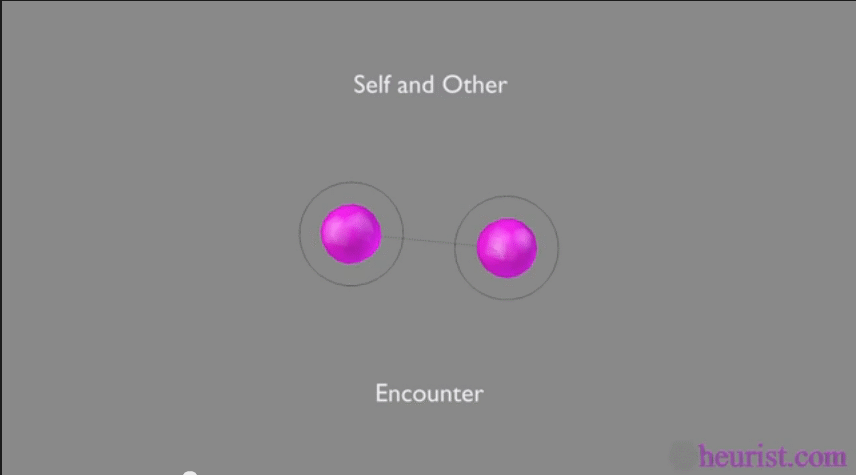
Knowledge Representation of Self and Other
This knowledge representation, which I made for a presentation in Nürnberg on April 29th, 2013, depicts a partial resonance domain with respect to sentient relation and orientation. The representation is not designed to be comprehensive in any respect, rather it is intended to help those who are not accustomed to viewing knowledge in this way.
It shows how, to quote Carl Sagan: “One voice in the Cosmic fugue.” can be represented more generally. There are certainly other possibilities with respect to relation and orientation between self and other.
You may need to stop this video occasionally as some of the transitions occur very quickly.I’ve indicated what is happening in the representation to aid in the interpretation of what is being shown.
I would appreciate any feedback you may want to give. I’d be pleased to answer any questions that may arise.
Thank you for watching!
UPDATE:
A question has come in from an anonymous source asking for clarification on the use of “Resonance Domain”.
A resonance domain is comprised of resonance fields. When one or more fields are being examined, the group is called a domain.
For further clarity I’d like to add that we are looking at two separate fields (sentient beings) in terms of the relation they participate in and the orientation they share with each other.
Fields are always composed of other sub-fields and contain even partial fields from other sources!
UPDATE: “Why do you use the word ‘sentient’ in your description?”
There are basically three types of entities in our universe:
1) Having some measure of interiority (concept of self).
2) Artifacts
3) Heaps
‘Self and other’ can come in any number of combinations:
The knowledge representation above requires that at least two of the participants are of type 1 (sentience) for this knowledge representation to hold.
Examples:
Type 1) human and type 1) dog will work.
Type 1) human and type 2) book will not work.
Type 1) human and type 3) rock will not work.
This way of looking at our Kosmos (multiverse) is called Mathesis Universalis.
For those interested in more on the subject, go to http://mathesis-universalis.com.
[PS: There are also the conditions that both participants are conscious of each other and that their shared consciousness is such that differences in semantics between them are ‘reconcilable’ (coherence). (for the scientists/mathematicians among us!)] 😉
 Heurist.me (Carey G. Butler)